


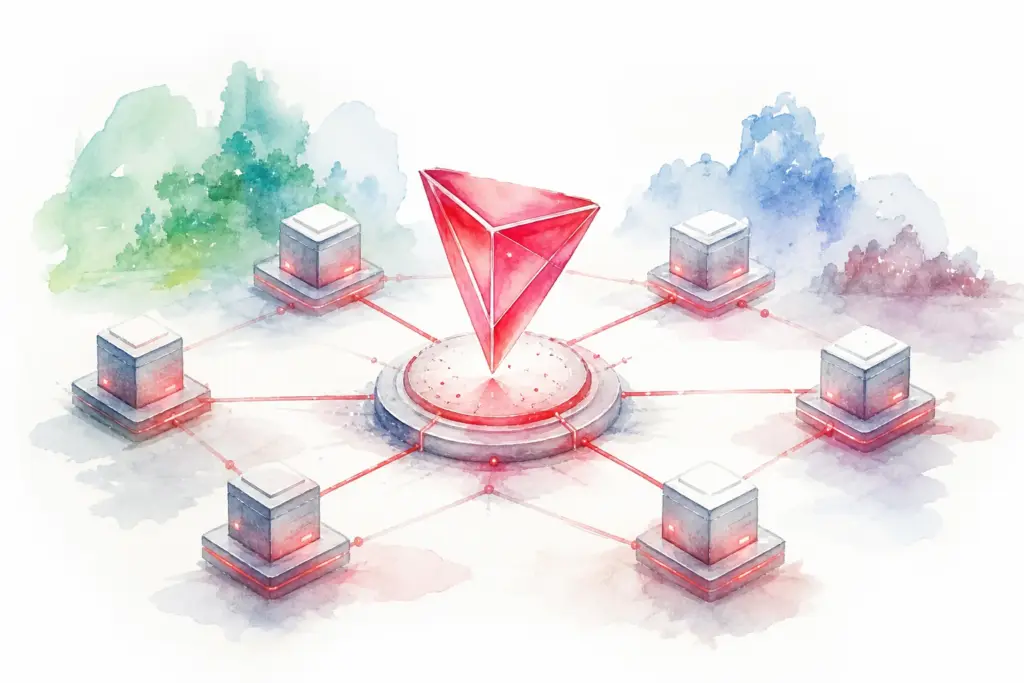
TRON’s staking mechanism offers TRX holders a unique value proposition: earn 4-7% APY while securing one of crypto’s most active networks through Delegated Proof of Stake. Unlike conventional staking, TRON uses a non-custodial freeze mechanism that simultaneously grants voting power and provides essential network resources—bandwidth and energy. This dual-purpose system powers the ecosystem that processes billions of transactions annually, including the majority of USDT transfers. Understanding how to freeze TRX, vote for Super Representatives, and optimize resource allocation unlocks both passive rewards and practical utility. This guide explains the complete mechanics and walks through the practical steps to start staking TRX effectively.
Understanding TRON’s Delegated Proof of Stake Consensus


TRON’s blockchain operates on a Delegated Proof of Stake consensus mechanism that prioritizes speed and efficiency through elected validators. Unlike traditional Proof of Work systems that require energy-intensive mining, or standard Proof of Stake networks where any token holder can validate, TRON concentrates block production among 27 elected Super Representatives who maintain the network through a rotating validation schedule.
What Makes DPoS Different
The DPoS model introduces a representative democracy to blockchain consensus. TRX holders don’t directly validate transactions themselves. Instead, they freeze their tokens to gain TRON Power, which serves as voting weight to elect Super Representatives. This separation between token holders and validators allows the network to process transactions rapidly while maintaining decentralization through continuous community voting. The system creates a competitive environment where 127 Super Representative candidates constantly vie for the 27 active positions, ensuring that underperforming validators can be voted out in favor of more reliable alternatives.
The Role of Super Representatives
Super Representatives function as the backbone of TRON’s transaction processing infrastructure. Each of the 27 elected SRs produces one block every 3 seconds in a predetermined rotation, creating a predictable and efficient block production cycle. This tight scheduling enables TRON to achieve high throughput without the block time variability seen in probabilistic consensus models. SRs earn block rewards and transaction fees for their validation work, which they often share with voters as staking rewards. The rewards structure incentivizes SRs to maintain high uptime, invest in robust infrastructure, and attract voter support through competitive reward-sharing programs that benefit the entire staking community.
Freezing TRX and Earning TRON Power
When you freeze TRX tokens on the TRON network, you convert them into TRON Power (TP), a mechanism that simultaneously grants you voting rights and provides essential network resources. This process forms the foundation of TRON’s delegated proof-of-stake consensus, where token holders actively participate in network governance without surrendering custody of their assets.
How Token Freezing Works
The freezing process occurs entirely on-chain through TRON wallets like TronLink or through direct smart contract interaction. When you freeze TRX, the tokens remain in your wallet but become locked and non-transferable for a minimum period. The conversion rate is straightforward: one frozen TRX equals one TRON Power. This TP serves as your voting weight when selecting Super Representatives who validate transactions and produce blocks.
Unlike centralized staking platforms, TRON’s freezing mechanism is completely non-custodial. Your private keys never leave your control, and the staking logic executes through TRON’s native protocol rather than third-party contracts. Once you decide to unfreeze, the network enforces a 14-day waiting period before your TRX becomes transferable again. This cooldown period prevents rapid stake movements that could destabilize network security.
Bandwidth vs Energy: Choosing Your Resource Type
TRON requires you to specify whether frozen TRX generates bandwidth or energy when initiating the freeze. Bandwidth covers simple TRX transfers and basic transactions, consuming approximately 200-300 bandwidth points per transfer. Energy powers smart contract executions, including TRC20 token transfers like USDT, which can require 15,000-65,000 energy units depending on contract complexity.
Most users freezing TRX for the first time should prioritize energy if they regularly interact with DeFi protocols or transfer stablecoins. Bandwidth regenerates quickly for basic users, but energy demands scale significantly with contract complexity. You can split your frozen TRX between both resource types by initiating separate freeze transactions, allowing flexible resource allocation based on your transaction patterns.
Step-by-Step: How to Stake TRX and Vote for Super Representatives
Staking TRX requires two distinct actions: freezing your tokens to obtain voting power, then allocating that power to Super Representatives. The process takes minutes through supported wallets and unlocks both resource benefits and voting rewards.
Freezing Your TRX
Start by accessing the staking interface in your TRON wallet. TronLink, the most widely used option, places the freeze function directly in its main dashboard under the “Resource” or “Stake” tab. Many centralized exchanges like Binance and Kraken also offer simplified staking interfaces that handle the technical steps automatically.
- Navigate to the freeze/stake section of your wallet and enter the amount of TRX you want to lock
- Select your resource type: choose bandwidth for regular TRX transfers and transactions, or energy if you frequently interact with smart contracts and TRC20 tokens
- Confirm the freeze transaction and pay the small bandwidth fee (typically 0.1-1 TRX)
Your frozen TRX immediately converts to TRON Power at a 1:1 ratio. One frozen TRX equals one TRON Power unit, which represents your voting weight in the network.
Casting Your Votes
With TRON Power in hand, you can now vote for Super Representatives. The voting interface appears in the same wallet section, typically labeled “Vote” or “Governance.”
- Browse the list of Super Representative candidates and review their reward rates, voting statistics, and contribution history
- Allocate your TRON Power to one or multiple SRs by entering vote amounts next to each candidate (your total votes cannot exceed your available TRON Power)
- Submit your votes and confirm the transaction
Votes remain active until you manually change them. You can redistribute votes between different SRs at any time without unfreezing your TRX. Most wallets display your accumulated rewards in real-time, with payouts distributed every 24 hours. Track your chosen SRs’ performance through their rank position and block production reliability to optimize your reward rate over time.
Understanding Staking Rewards and APY Rates
TRON staking rewards currently deliver returns between 4-7% APY, a range determined primarily by which Super Representative you select as your voting target. These rewards don’t appear automatically in your wallet—you must actively freeze your TRX and cast votes to become eligible for any distribution.
Where Staking Rewards Come From
Super Representatives generate income through two primary channels: block production rewards and transaction fees collected from network activity. Each time an SR produces a block, the TRON protocol allocates newly minted TRX as a block reward. Transaction fees from smart contract executions, token transfers, and other network operations create a secondary revenue stream. SRs then distribute a percentage of this combined income to the voters who supported their election, creating the staking rewards ecosystem.
The distribution model varies significantly across Super Representatives. Some SRs retain a larger portion of rewards to fund operations and development, while others maximize voter payouts to attract more support. This creates a competitive market where SRs must balance their operational needs against voter incentives.
Comparing Super Representative Reward Rates
Different Super Representatives publish their reward distribution policies, typically ranging from 60% to 100% of earnings returned to voters. High-distribution SRs offering 95-100% returns often compensate by charging project fees or running profitable dApps. Mid-tier SRs offering 80-90% distributions usually invest retained earnings into ecosystem development or validator infrastructure improvements.
Reward frequency also differs—some SRs distribute daily, others weekly or monthly. Payment methods vary between automatic wallet deposits and claim-based systems requiring manual withdrawal. The combination of distribution percentage, payment frequency, and SR reliability determines your actual realized APY. A 7% nominal rate becomes meaningless if an SR experiences downtime or delays payments by weeks.
Super Representatives: Selection and Reward Distribution
The TRON network operates through 27 elected Super Representatives who form the backbone of block production and transaction validation. These SRs compete continuously for their positions based on votes they receive from TRX holders, with the network also tracking 127 Super Representative candidates who stand ready to replace underperforming SRs.
Selection happens through a weighted voting system where every staked TRX equals one vote. Token holders can split their votes across multiple candidates or concentrate them on a single SR. The top 27 candidates by vote count earn active SR status and begin producing blocks immediately, while rankings update every six hours based on shifting vote totals.
SR Responsibilities and Infrastructure Requirements
Active Super Representatives shoulder significant technical and operational responsibilities:
- Maintaining high-performance nodes capable of processing thousands of transactions per second
- Producing blocks in a precise rotation schedule without downtime or delays
- Validating transactions and maintaining network consensus across all 27 nodes
- Deploying redundant infrastructure to prevent block production failures
- Engaging with the TRON community through governance proposals and updates
Most successful SRs operate geographically distributed server clusters with automated failover systems. Infrastructure costs run from several thousand to tens of thousands of dollars monthly, which SRs fund through block production rewards.
Voter Reward Distribution Models
Each Super Representative sets its own reward-sharing percentage, ranging from 0% to over 90% of earned block rewards. SRs publish their distribution rates publicly, creating competition for votes. Higher reward percentages attract more voters, but SRs must balance payouts against infrastructure costs and operational sustainability.
With over 2.3 million daily active addresses participating in network activities, voters regularly shift their support between SRs based on reward rates, uptime performance, and community contributions. This dynamic creates constant pressure on SRs to maintain competitive offerings while delivering reliable block production.
Unstaking: The Unfreezing Process and Liquidity Considerations
When you need to access your staked TRX, the unfreezing process returns your tokens to a liquid state, but it’s not instantaneous. TRON implements a 14-day waiting period from the moment you initiate an unfreeze request until those tokens become transferable again. This delay is a deliberate security measure to prevent rapid manipulation of voting power and network resources.
Initiating the Unfreeze
To unfreeze your TRX, access your wallet interface (TronLink, Ledger, or other compatible wallet) and locate your frozen balance under the resources or staking section. Select the amount you want to unfreeze and submit the transaction. The moment you confirm this action, you immediately lose the TRON Power associated with those tokens, which means your voting power for Super Representatives vanishes instantly. Similarly, the bandwidth or energy resources generated by that stake stop accruing right away.
What Happens During the 14-Day Period
During the two-week waiting period, your TRX exists in a frozen but non-productive state. You cannot transfer it, trade it, or stake it elsewhere. You also receive no voting rewards during this time since your TRON Power was revoked at the start of the unfreeze. The tokens simply wait in queue until the countdown completes.
This mechanism requires careful planning around your liquidity needs. If you anticipate needing TRX for transactions, trading, or other purposes, initiate the unfreeze well in advance. Users who stake all their TRX without maintaining a liquid reserve often find themselves unable to cover transaction fees or participate in time-sensitive opportunities while waiting for tokens to unlock.
Staking Strategies and Practical Considerations
Maximizing staking returns on TRON requires more than simply freezing TRX and selecting any available Super Representative. Strategic voters evaluate multiple factors before committing resources, particularly given that TRON hosts over 60% of USDT’s total supply as TRC20 tokens—staking provides the energy needed for these transactions.
Choosing the Right Super Representatives
SR selection directly impacts both reward rates and network reliability. Before voting, analyze each candidate’s historical uptime, reward distribution percentage, and community standing. Some SRs offer higher APY while others provide lower returns in exchange for additional services like dApp support or ecosystem grants. Block production consistency matters: an SR with frequent downtime reduces overall network efficiency and may signal infrastructure weakness.
Diversifying votes across multiple SRs mitigates single-point risk. Rather than allocating all frozen TRX to one representative, distribute voting power among three to five carefully vetted SRs. This approach protects against sudden reward changes or SR governance issues while maintaining competitive returns. Track reward payouts weekly to identify underperforming representatives early.
Balancing Resources for Your Usage Patterns
Understanding your transaction profile determines optimal resource allocation. Users who primarily send USDT TRC20 transfers consume significant energy per transaction—typically 31,895 energy units for a standard transfer. Freezing TRX for energy rather than bandwidth makes sense for frequent token movers. Conversely, wallets executing simple TRX transfers benefit more from bandwidth allocation, as these operations consume minimal energy.
Common misconceptions create unnecessary friction. Staking doesn’t mean sending tokens to another address; your TRX remains in your wallet throughout the freezing period. Rewards aren’t automatically distributed either—most SRs require manual claiming or specific opt-in procedures. Monitor your chosen SR’s reward distribution schedule and claim regularly to compound returns effectively. Calculate your monthly transaction costs against potential staking yields to determine if freezing TRX provides net savings compared to burning TRX for resources on-demand.
Start Staking and Participate in TRON Governance
TRON’s staking mechanism through Delegated Proof of Stake enables TRX holders to freeze tokens, gain voting power, and earn passive rewards while obtaining essential network resources. The non-custodial design keeps your private keys under your control throughout the process, distinguishing TRON from platforms requiring token transfers to third-party validators. This system secures a network processing billions of transactions and powering the majority of USDT transfers across all blockchains.
The practical benefits extend beyond passive income. Freezing TRX for energy eliminates transaction fees for USDT TRC20 transfers and DeFi interactions, while voting rights let you influence which validators secure the network. The competitive SR landscape ensures you can optimize returns by selecting high-performing representatives with transparent reward policies.
Begin by researching Super Representatives through TRON’s governance portals and community resources. Compare reward rates, uptime statistics, and community contributions to identify candidates aligned with your priorities. Choose a wallet that supports staking—TronLink offers the most comprehensive interface, while hardware wallets like Ledger provide additional security for larger holdings. Start with a partial stake to familiarize yourself with the freeze-vote-claim cycle before committing your full position. Active participation in TRON’s governance strengthens the ecosystem while generating returns on assets that would otherwise sit idle.